Samsung 990 2TB SSD: Công nghệ mới, tốc độ quen thuộc
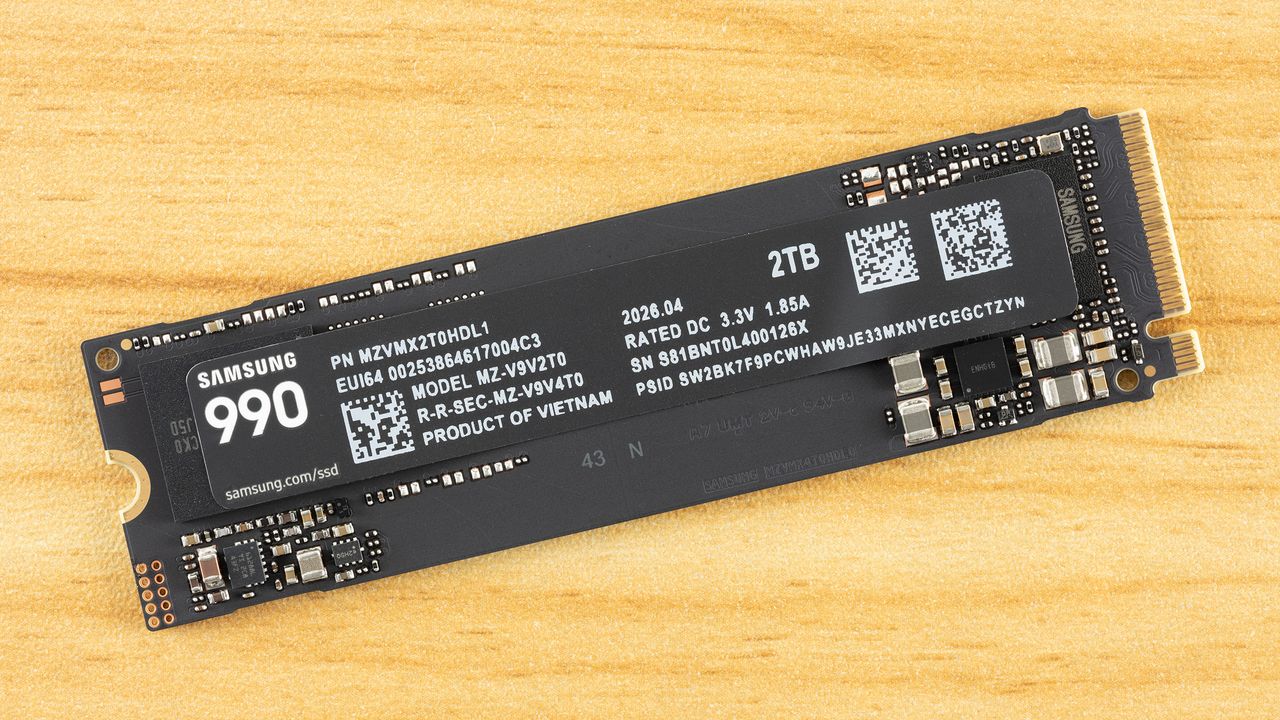
Samsung ra mắt ổ SSD 990 dựa trên công nghệ QLC, được định vị là ổ đĩa ngân sách với băng thông cao. Sản phẩm này mang đến công nghệ mới nhưng không phải là phiên bản Pro của Samsung.
Samsung is back with another solid-state drive, and this time it's something a little bit different. The 990 is a QLC-based 990 EVO Plus, positioned as a budget drive that can still push a lot of bandwidth. It’s a little late to the game and not quite what was rumored for the 990 QVO, but it does bring some new technology to the table. We’re always interested in seeing what Samsung puts out, and this time is no different. It should not be confused as being part of Samsung’s Pro line or, for that matter, the EVO line, so keep that in mind. The drive has its ups and downs, but in this challenging market, and for a budget drive, that’s to be expected. Samsung is still well-regarded for its name and reliable hardware, even as there has been a massive push towards enterprise, away from the consumer side. Samsung has, in fact, given some ground in the SSD space for many years, even as it produces some of the most common OEM drives. So while this is not a Crucial situation , it’s best to jump into this review with the right expectations about what this drive is and isn’t. It’s a budget drive with full Gen 4 throughput that hits the most common capacities with sufficient performance and power efficiency. It’s not meant to be a throne-taker. It’s also thankfully not another 990 EVO situation – that drive felt somewhat underwhelming by the time it arrived, even when pitted against budget drives – but the 990 is also not a QLC rallying call. It’s a competent drive that mostly hits the right notes, as intended. Given how scarce Samsung QLC drives have been, and how much demand its QLC flash surely has elsewhere, it can feel like Samsung is throwing consumers a bone, though it would be crass to put it that way. We instead think this is smart positioning by the company as it knows the future is with QLC and the technologies used in this flash (even if first shown two years ago at ISSCC) point firmly at an ambitious future. The 990 just lets you own a piece of that. Samsung 990 Specifications Product 1TB 2TB Pricing $269.99 $529.99 Form Factor M.2 2280 (Single-sided) M.2 2280 (Single-sided) Interface / Protocol PCIe 4.0 x4 / NVMe 2.0 PCIe 4.0 x4 / NVMe 2.0 Controller Samsung PiccoloQ Samsung PiccoloQ DRAM N/A (HMB) N/A (HMB) Flash Memory Samsung V9 QLC Samsung V9 QLC Sequential Read 7,150 MB/s 7,250 MB/s Sequential Write 6,450 MB/s 6,450 MB/s Random Read 700K IOPS 850K IOPS Random Write 1,100K IOPS 1,200K IOPS Power (R/W) 4.0W / 3.7W 4.3W / 3.8W Endurance 400 TBW 800 TBW Security TCG Opal V2.0 TCG Opal V2.0 Part Number MZ-V9V1T0 MZ-V9V2T0 Warranty 3-Year 3-Year The Samsung 990 is only available at 1TB and 2TB capacities, with MSRPs of $269.99 and $529.99, respectively. These prices are very high, as you can get competing drives like the Crucial P310 for substantially less, and in fact even the TLC-based WD Black SN7100 costs less. But Samsung has historically launched with MSRPs well above actual market price. You should be able to get the drive at significantly lower prices after launch, but the “Samsung tax” may still apply. We’ll get into what that means throughout the review. This limited capacity range is unfortunate, but enables Samsung to pack the flash into just one package, which reduces PCB space so that any OEM variant can be used in multiple M.2 form factors and will always be single-sided. Less than 1TB is also not enough for these denser dies if you want good performance. That leaves 1TB and 2TB as the target capacities, which also makes sense in a market where 4TB+ is getting exceptionally expensive. We’ll eventually see 2Tb dies to make single-package 4TB a reality, but that’s further along in Samsung’s roadmap. The drive can reach 7,250 / 6,450 MB/s for sequential reads and writes and up to 850K / 1,200K random read and write IOPS. Peak performance is attained at 2TB, where you have the optimal amount of interleaving or parallelization: Sixteen 1Tb dies means four dies for each of four flash channels, the typical ceiling.…